
Up to 10 million Americans live with OCD, yet findings from the IOCDF show that only a tiny fraction receive the treatment proven to help the most.
OCD is a serious, often debilitating condition that can derail school, work, relationships, and everyday functioning. Effective treatments exist, but most people struggle for years without being diagnosed or properly treated.
In America’s OCD Care Crisis: National Findings on the Failure of Effective OCD Treatment to Reach Patients, the IOCDF partnered with Guardian Research Network (GRN) and Resonance to review millions of deidentified U.S. health records and determine how many have been diagnosed with OCD and how many have received the recommended, evidence-based treatments. This analysis — the largest study of people with OCD to date — uncovered striking findings, yet yielded promising pathways to better support the millions of people suffering with OCD in the United States.
Key Takeaways
Up to 10M Americans likely live with OCD, yet only 1 in 6 receive a diagnosis.
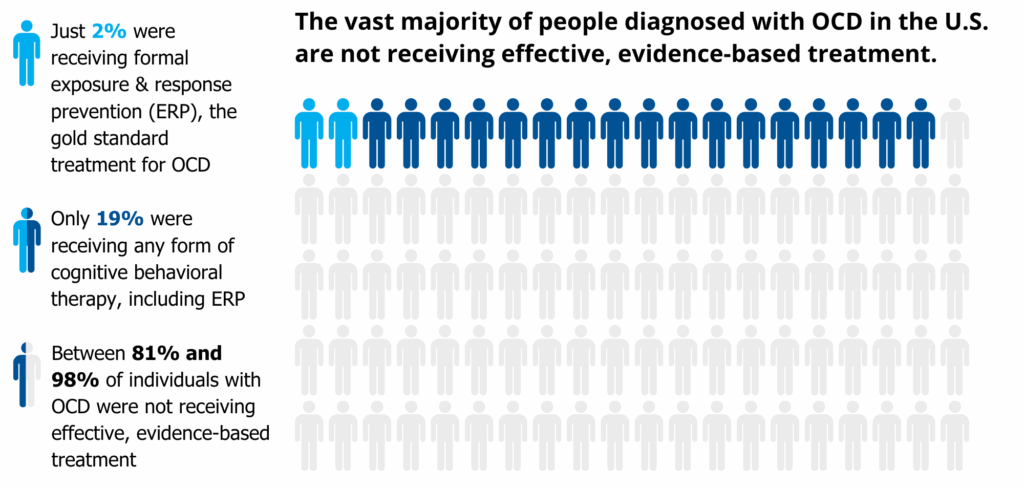
95% of people with OCD in the U.S. do not receive the most effective treatment.
Effective treatment exists — but millions aren’t getting it and are suffering needlessly.
People with OCD are being failed at every step: screening, diagnosis, referral, and treatment.
This crisis stems from systemic gaps.
OCD is underdetected
Around 3% of people are expected to experience OCD, but just 0.7% were identified in clinical records.
OCD is underreferred
Even among those identified, 70% were never referred for recommended therapy.
OCD is undertreated
Only 2% were documented as receiving ERP (exposure and response prevention), the gold-standard treatment.
OCD symptoms can overlap and coexist with other mental health disorders and can be influenced by medical causes, which can make it even more difficult to receive an accurate diagnosis or appropriate care.
The Good News: Proper Treatment Works
When people receive ERP and other evidence-based care, outcomes improve dramatically. People regain functioning, stability, and quality of life.
IOCDF's recommendations:
- Implement routine OCD screening in healthcare and mental health settings.
- Expand clinician training in OCD diagnosis and treatment.
- Strengthen adherence to professional treatment guidelines.
- Increase affordable access to evidence-based therapy.
- Raise accurate public awareness of what OCD really is and that it is treatable.
Training & Resources for Clinicians
Training for clinicians about the best practices for the diagnosis and treatment of OCD is essential to help many millions more individuals get access to the care they need to thrive. Please help share IOCDF’s learning opportunities with colleagues and professional networks. Our Training Institute provides evidence-based programs for clinicians at all stages of practice, including introductory on-demand courses, intensive training in CBT/ERP, online consultation groups, and advanced trainings in specialty topics within OCD.
- Start here: Free, on-demand OCD Basics webinar. Watch Now →
- Go deeper: Our on-demand webinar catalog covers fundamentals, modalities, related disorders, and comorbidities. Browse Courses →
- Check out IOCDF's Training Institute: Intensive CBT/ERP workshops, consultation groups, and advanced topics. Explore IOCDF Training →
- Become a Professional Member: Join a nationwide network; access CE, resources, and a provider directory listing. Become a Member →
- Help us improve: Take the Clinician Needs Assessment to shape IOCDF's programs and advocacy to close the treatment gap for millions. Take the Assessment →
How You Can Help
Change happens when people speak up, connect, and take action. Join us in building better access to effective treatment:
- Become a member of our grassroots advocacy community.
- Share this white paper and other IOCDF resources with your clinician and healthcare professionals.
- Donate to the IOCDF to support training programs, advance research, and raise awareness of OCD and related disorders.
The current state of treatment for OCD is sobering, but it is not the end of the story. OCD is treatable, recovery is possible, and change can happen as awareness grows and access expands. With continued effort, the gap between how many are struggling and how many receive effective care can begin to close. A brighter future is possible — and we can build it together.